
Advancing Pharmaceutical Formulation Development
The formulation of pharmaceutical drugs is a crucial step for identifying the appropriate dosage form, composition and production method in the drug development process. A drug may fail phase I clinical trials prior to effective absorption, if it cannot be administered in a stable form and limiting its market potential. In clinical trials, up to 90% of new therapeutics fail due to poor efficacy, unacceptable toxicity, and poor drug-like properties. The HPC team combines scientific innovation with operational feasibility and regulatory alignment throughout every stage of formulation development. Our expertise ranges from early-stage development support to Phase I and Phase II clinical trials, scale-up and transfer to commercial manufacturing for your new chemical entities (NCEs) and generic products.
Formulation Development Services
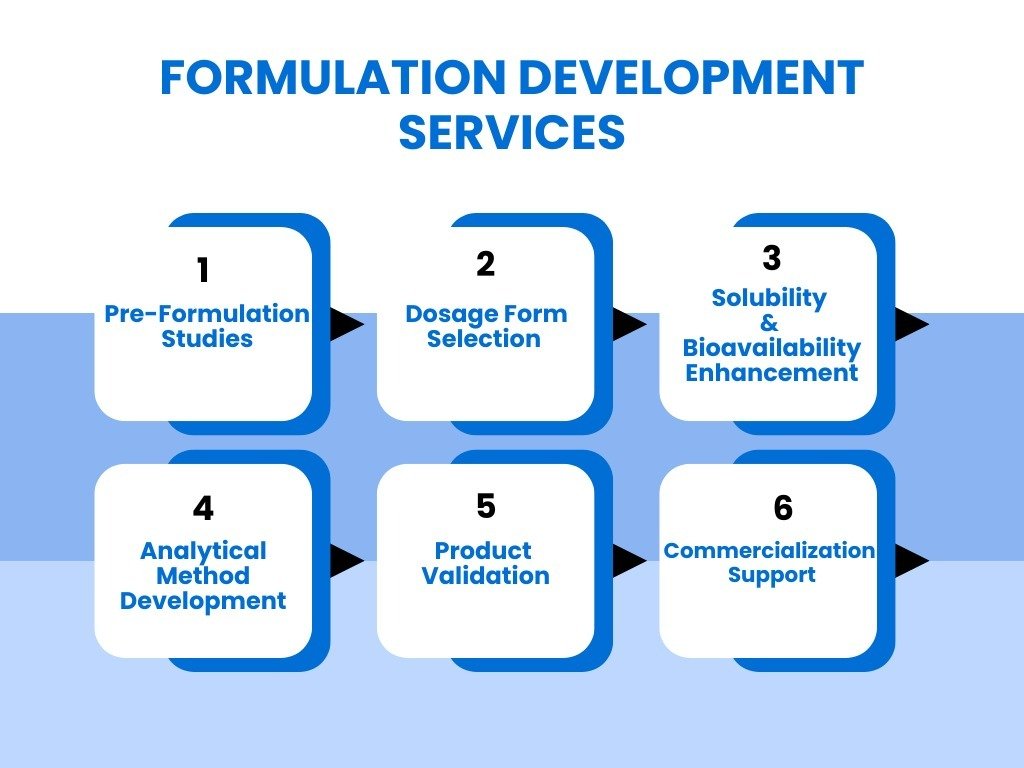
Formulation development is a multi-step process with distinct stages. HPC formulates and optimizes solid (tablets, capsules), liquid (solutions, suspensions, syrups), semi-solid (creams, gels, ointments) and injectable dosage forms. We optimize excipient compatibility including process selection and stability, dissolution and patient acceptability. All formulations are commercially scalable.
1.Preformulation Studies
HPC conducts the preformulation studies as a first step formulation development process to get a complete set of data about the physical and chemical properties of the active pharmaceutical ingredient (API). Given below the various steps which are carried out under these studies.
- Physicochemical Characterization: We comprehensively assess the active pharmaceutical ingredient (API) to grasp its fundamental physicochemical characteristics, such as stability profile, solubility, pKa, hygroscopic properties, and polymorphic behavior. We can produce stable, efficient and manufacturable drug products through comprehensive evaluation, which helps us predict how the therapeutic material will behave under various formulation techniques and storage conditions.
- Excipient Compatibility Studies: We investigate how API interacts with potential excipients to confirm the uniformity, safety and efficacy of the end-product. We can identify incompatibility at any stage of development through these studies which help us for successful commercialization.
- Solid-State Characterization: To determine the best choice for manufacturing and formulation process, we examine crystallinity, particle size, and polymorphic forms of number of solid states. This is done to ensure consistent performance during the development and production.
By carrying out these investigations, we develop crucial knowledge that governs the choice of dose form and designs formulation techniques, assuring that the final product is both patient-friendly and scalable.
2.Comprehensive Dosage Forms
At HPC, we design comprehensive dosage forms that satisfy production specifications as well as patient needs.
- Solid Dosages: We prioritize patient acceptability while designing tablets and capsules. We promote stability over the long term by carefully choosing the excipients. Our solid dosage formulations facilitate efficient production which can be utilized in both large-scale commercial production and clinical trials.
- Liquid Dosages: We evaluate excipient compatibility and viscosity to make oral solutions, syrups, and suspensions that ensure dependable chemical stability for a long duration.
- Semi-Solid Formulations: We design semi-solid formulations for ointment, gels, and creams with higher stability and therapeutic efficacy so that active components remain intact during storage while prioritizing ease of use and patient comfort.
- Injectable Preparations: When developing injectable products like sterile solutions, suspensions, and emulsions, we carefully consider sterility, stability and compatibility to suit both clinical and commercial requirements.
During development process, we facilitate smooth transition from lab to full production level with maximum reproducibility as commercial scalability is always our top priority.
3.Enhanced bioavailability and solubility
At HPC, we boost bioavailability, therapeutic effects and practical production viability with our effective formulation techniques.
- Amorphous Dispersions and Particle Size: Drugs with poor solubility and poor absorption frequently face challenges which eventually affect their therapeutic efficiency. We utilize modern particle engineering methods like amorphous dispersion methods to boost bioavailability and dissolving rates by enhancing surface area and decreasing crystallinity which guarantees improved clinical effectiveness.
- Ideal Solid & Salt Forms: A crucial stage in the developing of a formulation is choosing the best salt or solid form. We assess salts and their polymorphs for increasing solubility, dissolving rates, chemical stability and manufacturability. By choosing the best form, we guarantee the drug molecule functions properly at every stage of growth and development.
- Lipid-Based & Advanced Delivery Systems: We create cutting-edge lipid-based and advanced medication delivery systems for compounds with complicated absorption or poor solubility. These solutions preserve mass production, maximize therapeutic results and enhance bioavailability.
Our objective while dealing with low-solubility molecules is to make them feasible for large-scale manufacture in addition to enhancing their medicinal efficacy. We thoroughly examine each strategy for viability, cost and compliance with regulations to guarantee enduring business profitability.
4.Analytical Method Development
At HPC, developing analytical methods is viewed as an essential aspect of pharmaceutical development, rather than merely a regulatory obligation. By well-designing process, each product launched into the market continuously satisfies established quality, safety, and effectiveness criteria. We concentrate on developing feasible, practical and repeatable techniques which facilitate both research and commercial production.
- Reliable Analytical Techniques: To precisely assess the stability, purity and degradation characteristics of pharmaceutical substances and their products, we develop and refine analytical techniques. Our skills encompass methods like HPLC, UV-Visible spectrophotometry, dissolution assessment and impurity analysis to systematically refine each technique to guarantee accuracy, responsiveness and appropriateness for controlled standard quality assessments.
- Regulatory Compliance: To ensure complete regulatory acceptability, we validate analytical procedure following ICH Q2(R1) specifications. We evaluate different factors like range, robustness, accuracy, precision, linearity and sensitivity to guarantee our approaches are scientifically valid and entirely in line with worldwide regulatory standards.
- Evaluation of Stability & Contaminants: To comprehend product performance under stress conditions, we carry out forced degradation assessments and stability indicating tests to accurately recognize possible degradation routes and consistently monitor variations in product quality as time progresses.
- Development and Process Enhancement: Optimal formulation development and process refinement are actively supported by analytical results through diligent observation of key characteristics. We assist in preserving consistency between batches and pinpointing opportunities for enhancing manufacturing efficiency.
We provide accurate, scalable and consistent analytical solutions that support every stage of drug development, from preliminary research to market launch and subsequent follow-up, by fusing strong analytical abilities with regulatory expertise.
5.Product Validation
Product validation confirms that product maintains its quality, safety and effectiveness not just once but consistently in every batch to fulfil the regulatory standards.
- Critical Process Parameters (CPPs) and Critical Quality Attributes (CQAs): The main component of validation is to determine the parameters and quality characteristics that directly affect the quality and safety of end-product. For solid dosage forms, we continuously regulate different phases like mixing, granulation, compression, drying, and coating. To ensure consistency between batches, characteristics including viscosity, flow behavior, and homogeneity are closely monitored in the case of liquid and semi-solid products.
- Pilot and Commercial Scale Confirmation: Verifying process performance at various manufacturing scales is a further essential element in formulation development. For this confirmation, we test the formulation first at pilot scale and subsequently at commercial scale to guarantee reproducibility and a seamless scale-up. So that any variability or processing issues get resolved prior to the start of commercial production level.
- Risk Mitigation: Validation operations also incorporate risk assessment. We can find possible failure areas early on by performing stress assessments and examining worst-case scenarios. This proactive strategy reduces manufacturing risks and preserves process stability.
- Regulatory and Documentation Support: We carefully document every validation activity to meet legal requirements. Our documentation aligns with regulatory standards including EMA, FDA, and ICH and supports full readiness for inspections, audits and regulatory submissions.
- Process Improvement: The validation is not performed once but a continuous improvement cycle. For continuous improvement, we periodically conduct validation studies to boost productivity, simplify processes during the course of drug’s lifecycle.
By conducting thorough product validation, we make sure that every drug is ready for commercialization at a large-scale, with reliable quality and safety for both patients and stakeholders.
6.Commercialization Support
At HPC, we connect laboratory breakthroughs with industrial production to transform lab-scale formulations into scalable processes that are ready for inspection, efficient, legal, and profitable in a commercial context. We prevent expensive delays to guarantee a seamless transition from development to full-scale production.
- Assistance with Technology Transfer: We offer detailed support throughout the formulation transitions, manufacturing procedures and control strategies from lab or pilot scale to commercial production sites, guaranteeing uniformity and replicability at all phases.
- Preparation of CMC Documentation: Our team develops and aligns Chemistry, Manufacturing, and Controls (CMC) documentation in accordance with FDA, EMA, and ICH guidelines, supporting successful regulatory submissions and approvals.
- QbD-Based Control Strategies: By applying Quality by Design (QbD) principles, we design scientifically robust control strategies that minimize variability and maintain consistent product quality throughout the manufacturing process.
Through the implementation of Quality by Design (QbD) principles, we create scientifically based control strategies that minimize variability, ensure product consistency, and enhance overall process reliability. We follow international regulatory requirements and ICH Q8-Q11 criteria throughout the product lifecycle. We assist our clients in lowering development risks by combining formulation knowledge and commercialization strategy, also managing costs, ensuring scalability and speeding up time to market launch.
Collaborate with us to transform your vision into reality.
At Hayat Pharmaceuticals Consulting, we offer a truly flexible service with our highly experienced formulation specialists, which will help you to develop the optimal formulation and manufacturing processes for your drug product. Bringing quality and safety to life, we offer Fast to Clinic Formulation expertise to help you to exceed quality and meet regulatory standards.
Contact us: