
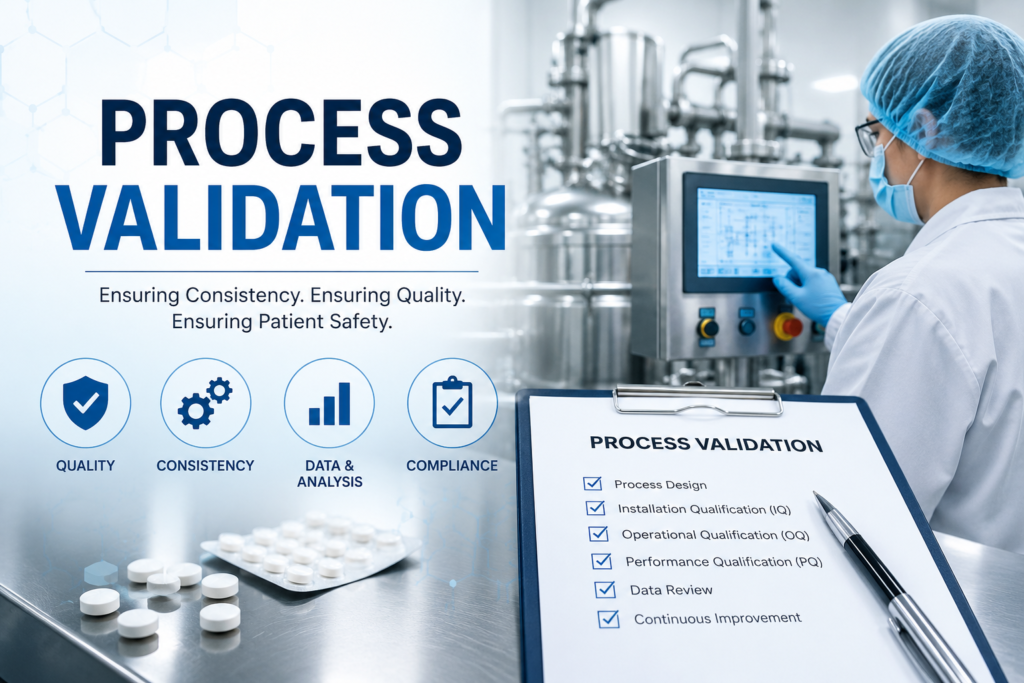
Process Validation in 2026: Meeting FDA and EMA Expectations
“Process validation is not a one-time event. It is a lifecycle commitment that links science, risk management, and regulatory compliance from Day 1 through commercial manufacture.”
In 2026, pharmaceutical manufacturers face a regulatory environment that is more data-driven, more transparent, and more demanding than ever before. Both the U.S. Food and Drug Administration (FDA) and the European Medicines Agency (EMA) have reinforced lifecycle-based process validation frameworks, and inspection teams are scrutinizing compliance with increasing rigor.
Whether you are preparing a New Drug Application (NDA), an Abbreviated NDA (ANDA), or a Marketing Authorization Application (MAA) for the EU market, understanding the current expectations of both agencies is essential for approval, commercial success, and patient safety.
This article provides a comprehensive overview of what FDA and EMA expect from process validation programs in 2026, where the two frameworks converge and diverge, and how pharmaceutical companies can build validation strategies that satisfy both regulators simultaneously. To learn more about how we support these programs, visit our pharmaceutical consulting services.
Why Process Validation Matters More Than Ever in 2026
Process validation serves one critical purpose: to provide documented, scientific evidence that a manufacturing process consistently delivers a product that meets its predetermined specifications and quality attributes. In 2026, several forces are making this discipline more consequential:
- Increased FDA pre-approval inspections (PAIs) scrutinizing validation packages before NDA/ANDA approvals
- EMA’s evolving Annex 15 enforcement and post-Brexit MHRA alignment creating multi-jurisdictional complexity
- Growing pipeline of complex biologics, peptides, and antibody-drug conjugates (ADCs) that demand more sophisticated validation strategies
- AI and digital tools transforming how Continued Process Verification (CPV) data is collected and analyzed
- Tariff-driven supply chain reshoring pressuring manufacturers to revalidate processes at new or alternative sites
The FDA Process Validation Framework: Three Stages, One Lifecycle
The FDA process validation guidance (2011) remains the foundational document for U.S. compliance. It defines process validation as the collection and evaluation of data, from the process design stage through commercial production, which establishes scientific evidence that a process is capable of consistently delivering quality product.
Stage 1: Process Design
This stage captures process knowledge developed during pharmaceutical development and scale-up. Key activities include Design of Experiments (DoE), identification of Critical Process Parameters (CPPs) and Critical Quality Attributes (CQAs), development of a Control Strategy, and process risk assessments using tools such as FMEA. In 2026, FDA reviewers expect sponsors to demonstrate robust scientific rationale for the selected design space.
Stage 2: Process Performance Qualification (PPQ)
PPQ confirms that the commercial manufacturing process performs as designed under routine conditions. FDA expects a statistically justified number of PPQ batches, enhanced monitoring of process parameters and CQAs, sampling plans based on statistical principles, and full batch records reviewed against pre-determined acceptance criteria.
Stage 3: Continued Process Verification (CPV)
CPV is the ongoing monitoring program that assures the process remains in a state of control during routine production. FDA expects a formally documented CPV program with Statistical Process Control (SPC) charts, capability indices (Cpk, Ppk), periodic trending reviews, and integration of CPV data into Annual Product Reviews (APRs) and Product Quality Reviews (PQRs).
The EMA Process Validation Framework: Annex 15 and the Lifecycle Approach
EMA’s process validation requirements are governed by Annex 15 of the EU GMP Guidelines, revised in 2015. The EMA framework aligns philosophically with FDA’s lifecycle model but differs in several structural and documentation requirements.
The Validation Master Plan (VMP)
Unlike the FDA, which does not mandate a Validation Master Plan but expects an equivalent structured document, EMA explicitly requires a VMP. This document must define the scope, responsibilities, and timelines for all validation activities across the facility and is a common GMP inspection focus point.
EMA’s Three Approaches to Process Validation
- Traditional Approach: Fixed process with predetermined acceptance criteria; typically requires at least 3 process validation batches
- Continuous Process Verification (CPV): Uses real-time monitoring and statistical tools to demonstrate control
- Hybrid Approach: Combines both; particularly useful for biologics and complex formulations
Concurrent Validation
EMA allows concurrent validation in exceptional circumstances, for example for products manufactured infrequently or for rare disease therapies. This flexibility has become more relevant in 2026 given the regulatory emphasis on advanced therapies and personalized medicines. Explore our regulatory affairs and compliance services to see how we help clients navigate these pathways.
FDA vs. EMA: Key Differences at a Glance
| Criterion | FDA (USA) | EMA (EU) |
| Governing Document | FDA Process Validation Guidance 2011 | EU GMP Annex 15 (2015) + EMA Guideline |
| Validation Master Plan | Not mandated; equivalent document expected | Explicitly required |
| Primary Focus | Scientific justification, protocols, and data | Scope, responsibilities, and timelines |
| Number of PV Batches | Science-based; 3 is common but not fixed | Minimum 3 traditional; CPV-based flexible |
| Lifecycle Stages | 3 Stages: Design, PPQ, CPV | Traditional, CPV, Hybrid approaches |
| Concurrent Validation | Very limited; exceptional circumstances only | Permitted with prior justification |
| Digital/AI Tools | Encouraged for CPV; guidance evolving | Accepted within validated systems (GxP) |
| Inspection Trigger | Pre-Approval Inspection (PAI) for NDA/ANDA | GMP inspection pre-authorization and post |
Critical Areas of Focus for 2026 Compliance
1. Risk-Based Validation Planning
Both FDA and EMA expect a risk-based approach to validation. Higher-risk processes such as aseptic manufacturing, complex biologics, or new synthesis routes demand more extensive validation evidence. Quality Risk Management (QRM) frameworks aligned with ICH Q9 are expected to be embedded throughout the validation lifecycle in 2026.
2. Process Analytical Technology (PAT) Integration
The integration of PAT tools such as real-time sensors, in-line analyzers, and near-infrared spectroscopy into validation programs is increasingly expected, particularly for continuous manufacturing and biologics. Both agencies support PAT as a means to enhance process understanding and reduce reliance on end-product testing.
3. Cleaning Validation and Shared Equipment
Cleaning validation remains a hot-button inspection topic in 2026. FDA and EMA both expect health-based exposure limits (HBELs) to be used for establishing acceptance criteria, a requirement that many manufacturers are still catching up on.
4. Validation of Digital Systems and AI Tools
As AI-powered analytics tools increasingly support CPV and process monitoring, regulators are developing clearer expectations for their validation. Digital tools used in GMP contexts must be validated, qualified, and auditable under both FDA guidance and EMA Annex 11 (Computer-Validated Systems) expectations.
5. Post-Approval Changes and Comparability
Supply chain disruptions and reshoring pressures are driving an increase in post-approval manufacturing changes in 2026. Both agencies require that process validation protocols be updated and new validation data generated when process changes exceed defined thresholds, a major compliance risk if not proactively managed.
Common Process Validation Pitfalls That Lead to FDA/EMA Findings
- Inadequate Stage 1 documentation: CPPs and CQAs identified without robust scientific rationale
- PPQ batches not representative: Using best-case conditions rather than commercial-scale, routine conditions
- CPV programs on paper only: SPC charts generated but not reviewed, trended, or acted upon
- Cleaning validation using outdated limits: Not transitioning to HBEL-based acceptance criteria
- Validation Master Plan (VMP) not kept current: Not updated when processes or equipment change
- Analytical method validation gaps: Methods used in PV not fully validated per ICH Q2(R1)
- Incomplete change control: Manufacturing changes implemented without formal impact assessments on validated state
How Hayat Pharmaceuticals Consulting Supports Your Validation Programs
At Hayat Pharmaceuticals Consulting, we provide end-to-end process validation support designed to meet both FDA and EMA expectations, from early development through commercial manufacturing and beyond.
Our team of seasoned regulatory and technical experts brings hands-on experience across:
- Process Validation Master Plans and risk-based validation strategies aligned with FDA and EMA guidelines
- PPQ Protocol design, execution support, and final report preparation
- Continued Process Verification (CPV) program development with statistical methodology
- Mock Pre-Approval Inspections (PAIs) to stress-test your validation package before FDA review
- GMP Audits evaluating the current state of your validation lifecycle against current agency expectations
- Regulatory filing support: integrating process validation data into NDAs, ANDAs, IMPDs, and DMFs
- Post-approval change management: impact assessments, comparability protocols, and revalidation strategies
Whether you are a start-up approaching your first PPQ campaign or an established manufacturer preparing for a PAI, HPC delivers the strategic depth and technical precision to ensure your validation program stands up to scrutiny.
Ready to strengthen your process validation program? Visit hpc-us.com or contact us at uhayat@hpc-us.com / +1-415-686-8822 to schedule a consultation.
Conclusion
Process validation in 2026 is not simply a regulatory checkbox. It is the scientific foundation upon which drug quality, patient safety, and regulatory success are built. With FDA and EMA both operating from lifecycle-based frameworks that emphasize continuous monitoring, risk management, and documented scientific rationale, pharmaceutical manufacturers must treat validation as an ongoing, integrated discipline rather than a project that ends with PPQ completion.
Organizations that invest in robust, lifecycle-aligned validation strategies, supported by experienced consultants, modern digital tools, and proactive regulatory engagement, will be best positioned to achieve approvals, pass inspections, and deliver quality medicines to patients worldwide. Learn more about our end-to-end pharmaceutical consulting services.
Frequently Asked Questions (FAQ)
What is the difference between FDA and EMA process validation requirements?
FDA follows a three-stage lifecycle model (Process Design, PPQ, CPV) with a focus on scientific justification and data. EMA Annex 15 requires a formal Validation Master Plan (VMP) and recognizes three approaches: Traditional, Continuous Process Verification, and Hybrid. Both frameworks align on the lifecycle concept but differ in documentation structure and flexibility.
How many batches are required for process validation?
Neither FDA nor EMA mandates a fixed number of validation batches. Three batches is the conventional minimum for traditional validation, but the number must be scientifically and statistically justified based on process variability, batch size, and complexity. FDA explicitly states the number should be based on science, not tradition.
What is Continued Process Verification (CPV)?
CPV is Stage 3 of FDA’s validation lifecycle, an ongoing program of monitoring process parameters and product quality attributes during routine commercial production, using statistical methods to confirm the process remains in a state of control. Both FDA and EMA consider CPV a required, not optional, component of a compliant validation program.
What is the role of process validation in FDA Pre-Approval Inspections (PAIs)?
During a PAI, FDA investigators specifically review process validation documentation to confirm the manufacturing process can consistently produce a product meeting specifications. Inadequate or incomplete validation packages are one of the most common causes of PAI findings and delayed NDA/ANDA approvals. Explore our Mock PAI and GMP audit services to prepare your team.